What Is the BODMAS Rule? A Simple Guide for Parents
As a math teacher, one of the most common questions I hear from parents is:
"Why does my child make mistakes in simplification even when they know addition and multiplication?"
In most cases, the issue is not calculation — it is understanding the correct order of operations, which is where BODMAS (or PEMDAS) becomes very important.
In this blog, I want to explain what BODMAS means, why students get confused, and how the learning level changes from Class 3 to Class 7.

Swarnali Saha
Founder, Welcome2Maths | 15+ years as a Math Teacher & Life Skills Coach
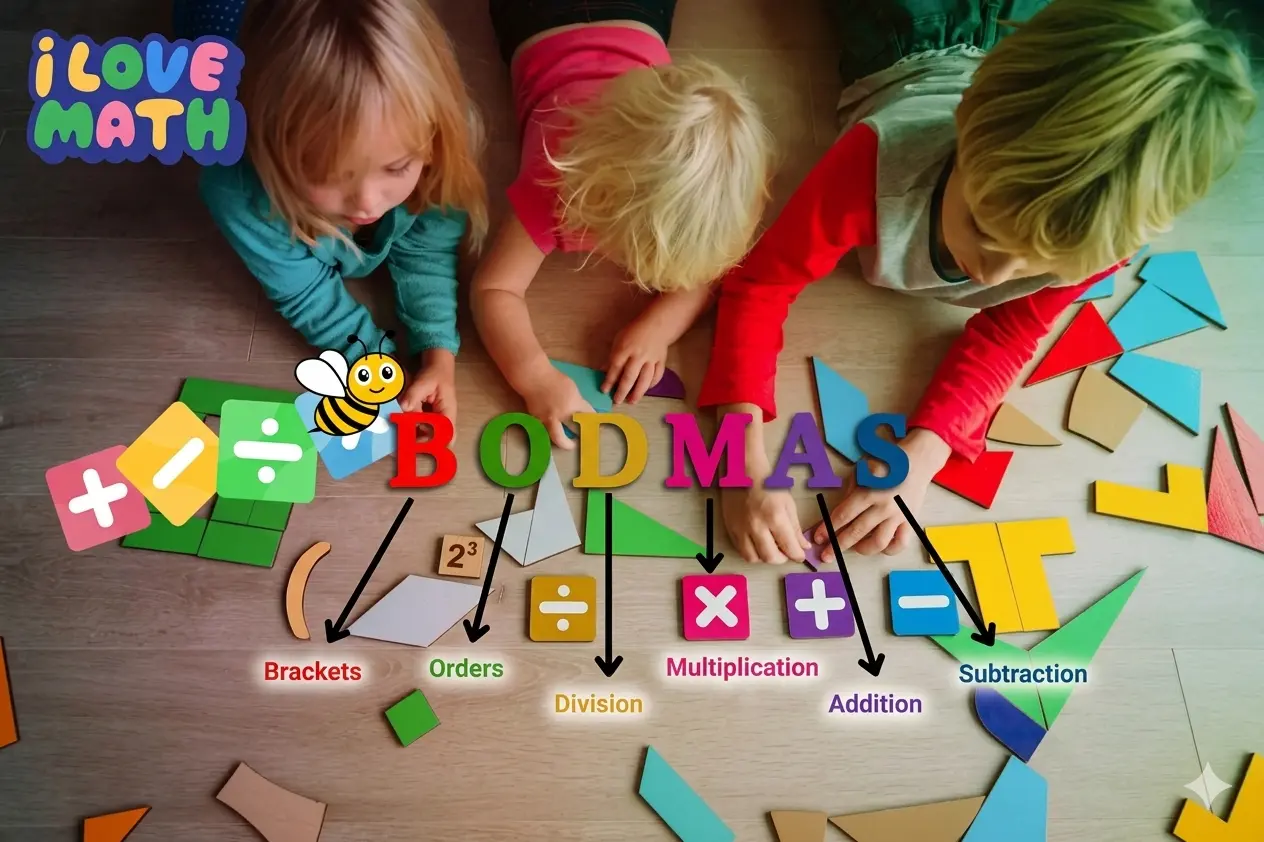
What Is the BODMAS Rule?
As a math teacher, I always explain BODMAS in a very simple and practical way.
BODMAS is an acronym that helps students remember the correct order of operations while solving any mathematical expression.
It stands for:
👉 B – Brackets
👉 O – Orders (powers, roots, etc.)
👉 D – Division
👉 M – Multiplication
👉 A – Addition
👉 S – Subtraction
This rule ensures that everyone solving the same expression gets the same correct answer.
Without BODMAS, students may solve in random order — and that leads to mistakes.
What Is PEMDAS? Is It Different from BODMAS?
Many parents get confused when they see PEMDAS instead of BODMAS.
In some regions (especially the USA), students learn PEMDAS:
👉 P – Parentheses
👉 E – Exponents
👉 M – Multiplication
👉 D – Division
👉 A – Addition
👉 S – Subtraction
But the truth is:
✅ BODMAS and PEMDAS mean the same thing
✅ Both guide students to follow the correct order
✅ Only the names are slightly different
So whether your child learns BODMAS or PEMDAS, the concept remains exactly the same.
Why Students Get Confused in BODMAS
Over the years, I have noticed that students struggle with simplification mainly because of these habits:
❌ Solving from left to right directly
❌ Mixing multiplication and addition randomly
❌ Ignoring brackets
❌ Forgetting that multiplication comes before addition
That’s why answers often go wrong — even when the student knows the tables.
Let’s Understand BODMAS with Simple Examples
Example 1
8 + 2 × 5
Wrong Way:
8 + 2 × 5
= 10 × 5
= 50 ❌
Correct Way (Using BODMAS):
2 × 5 = 10
8 + 10 = 18 ✔️
Example 2
15 − 3 × 4
Correct Way:
3 × 4 = 12
15 − 12 = 3 ✔️
Example 3 (With Brackets)
(6 + 4) × 3
Solve Brackets First:
6 + 4 = 10
10 × 3 = 30 ✔️
These small examples help children visually understand why order matters.
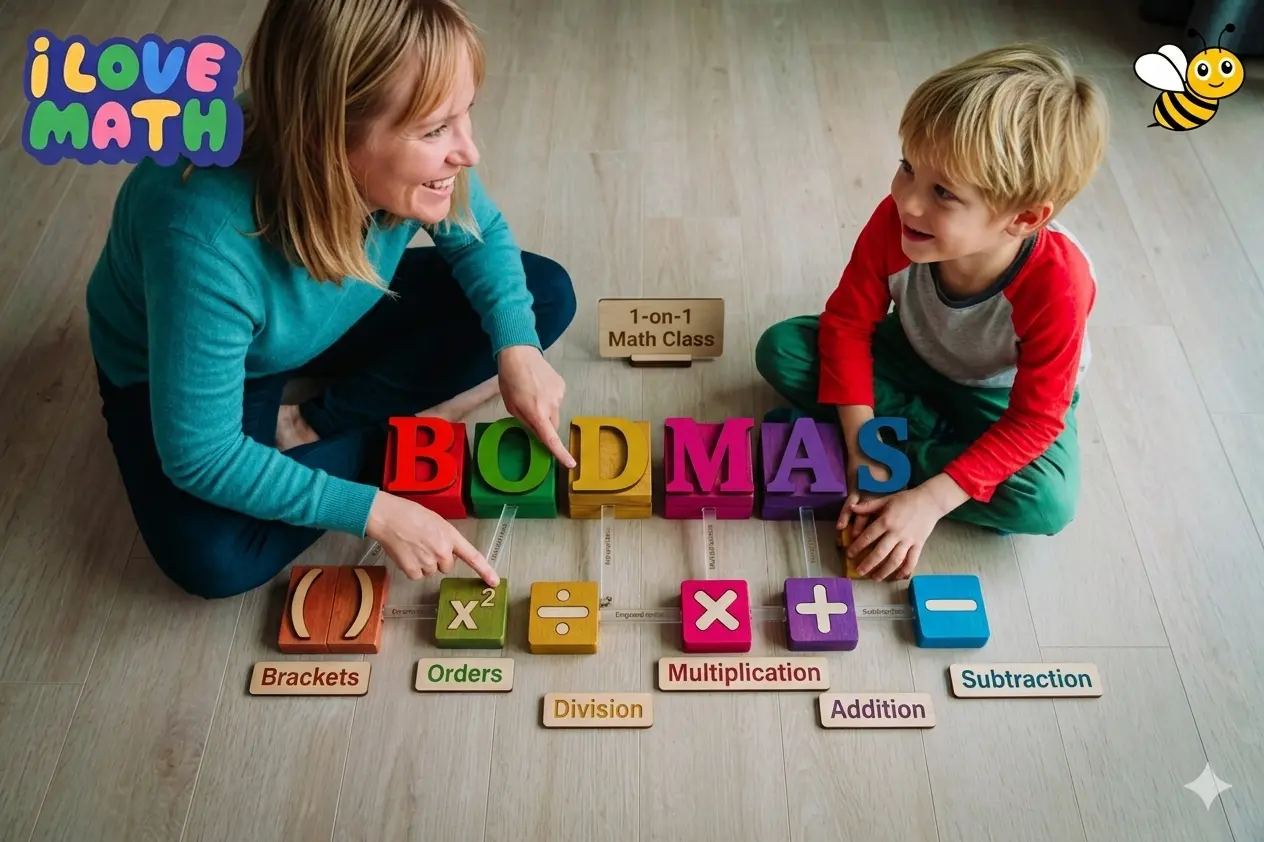
How BODMAS Is Different for Class 3 Students
Many parents are surprised when I tell them that Class 3 students also learn basic BODMAS, but in a very simple form.
At this stage, children do not need full BODMAS.
They only need to understand:
✅ Multiplication before Addition
✅ Simple brackets
✅ Basic simplification
Example Suitable for Class 3
5 + 3 × 2
3 × 2 = 6
5 + 6 = 11
That’s enough at this level.
As a teacher, I always keep Class 3 learning simple and visual, so children do not feel overwhelmed.
How BODMAS Becomes More Advanced in Class 6 and 7
From Class 6 and 7, the difficulty increases.
Students begin working with:
✅ Integers (negative numbers)
✅ Different types of brackets
✅ Bar brackets
✅ Nested brackets
This is where many students start making mistakes if their basics are not strong.
Types of Brackets Students Learn in Class 6–7
At higher classes, students learn different types of brackets, such as:
👉 Bar (—)
👉 Parentheses ( )
👉 Curly Brackets { }
👉 Square Brackets [ ]
And they must solve them in the correct order.
Bracket Order:
1️⃣ Bar
2️⃣ ( ) Parentheses
3️⃣ { } Curly
4️⃣ [ ] Square
Many students struggle here — especially when negative numbers are involved.
Example with Integers (Class 6–7 Level)
−5 + (8 − 3 × 2)
Step 1: Solve inside brackets
3 × 2 = 6
8 − 6 = 2
Step 2: Continue
−5 + 2 = −3 ✔️
This type of question requires both:
✔️ BODMAS
✔️ Understanding of negative numbers
That’s why practice becomes very important at this stage.
Common Mistakes I See as a Teacher
In my classes, I often notice these mistakes:
❌ Ignoring negative signs
❌ Solving addition before multiplication
❌ Missing bracket order
❌ Forgetting multiplication tables
❌ Rushing without checking steps
These mistakes are very common, but they can be corrected with guided practice.
How Parents Can Help Their Child Learn BODMAS
Parents don’t need to teach advanced math — but they can support practice in simple ways.
Here’s what I usually recommend:
✅ Encourage step-by-step solving
✅ Remind children to look for brackets first
✅ Ask them to say the rule aloud
✅ Give small daily practice
✅ Focus on accuracy first, speed later
Even 10 minutes of daily practice makes a big difference.
Why Strong BODMAS Skills Are So Important
BODMAS is not just a small chapter — it supports many future topics like:
📘 Algebra
📘 Fractions
📘 Integers
📘 Simplification
📘 Equations
If students make mistakes in BODMAS, they struggle in almost every higher math topic.
That’s why I always give special attention to simplification practice in my classes.
Final Thoughts from My Teaching Experience
As a math teacher, I have taught BODMAS to students from Class 3 to Class 7, and one thing I clearly see is:
Students who learn BODMAS correctly early make fewer mistakes later.
For younger students, it should be simple and visual.
For older students, it should be structured and practiced regularly.
With the right guidance and steady practice, every child can master BODMAS with confidence.
© 2020 welcome2maths. All rights reserved